Local SEO for dentists is the quiet reason one practice stays booked solid while the one down the street keeps refreshing an empty calendar. And here’s the part that stings: it usually has nothing to do with who’s the better dentist.
You could have the steadier hands, the nicer office, the patients who actually send holiday cards. None of that helps the person three blocks away at 9pm, jaw throbbing, thumbing “dentist near me” into their phone. They’re not going to ask around. They’re going to tap the first practice that looks close, open, and trusted, and they’re going to call it. If that practice isn’t yours, you never even knew the patient existed.
That moment, repeated hundreds of times a month across your city, is the whole game now. Nobody reaches for the Yellow Pages. They search, they glance, they tap. The good news? Showing up in that moment is mostly a set of fixable, unglamorous tasks, and you can start the first ones this afternoon. Let me walk you through what actually moves the needle, and just as importantly, what’s a waste of your time.
Why Local SEO for Dentists Works Differently
It helps to know what you’re up against. Google doesn’t rank your practice the way it ranks some blog post about the history of fluoride. Local results run on their own quiet logic, and that logic comes down to three things Google weighs every single time someone searches.
- Relevance, how well your practice matches what the person actually typed. Search “pediatric dentist,” and a profile clearly built around kids and families tells Google, yes, this one.
- Proximity, how close you physically sit to the searcher. And here’s the uncomfortable truth most guides tiptoe around: proximity is the single biggest factor in the whole equation. By the most recent industry survey, it drives more than half of who shows up.
- Prominence, how well known and trusted you look online, measured mostly through your reviews and how consistently your practice shows up across the web.
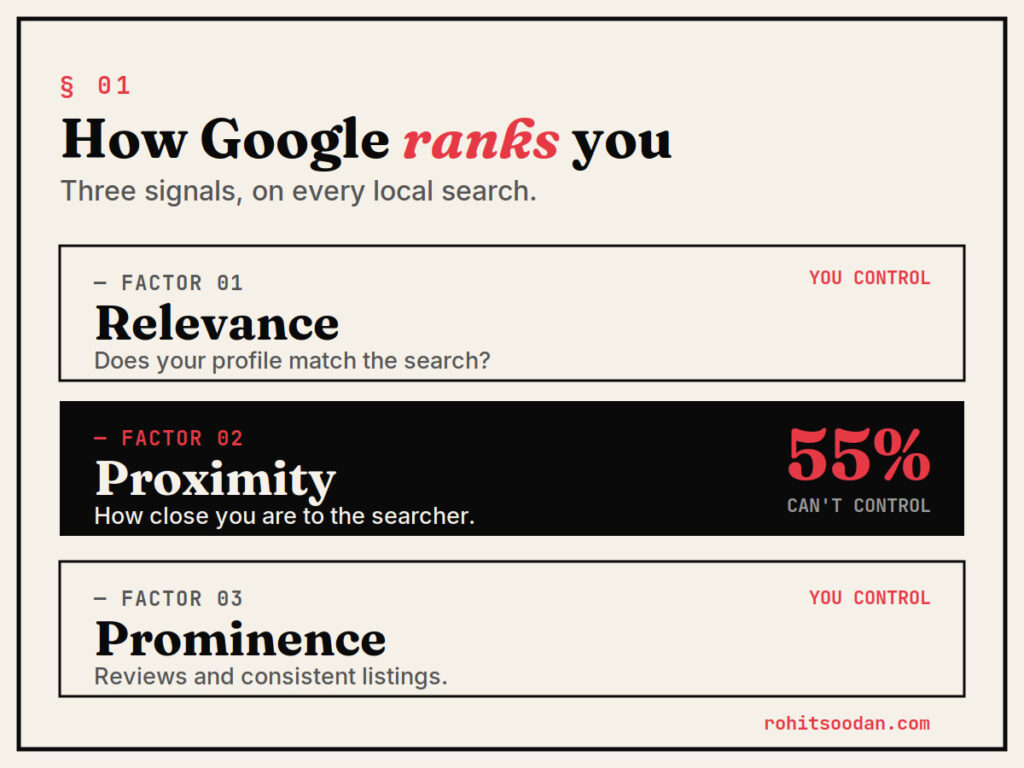
So one of the three big levers, distance, is simply out of your hands. Your office sits where it sits. That’s not a reason to shrug, though. It’s a reason to squeeze everything you can out of the two levers you do control, because that’s where the practices winning at dental SEO are quietly pulling ahead.
You can’t move your office closer to every patient. So win on the two things you can actually control: relevance and reviews.
Your Google Business Profile Is the Foundation
If you only fix one thing this month, fix this. Your Google Business Profile, that free listing powering the little map at the top of the results, is the most valuable square of real estate you own online. For a lot of practices it pulls in more new-patient calls than the website ever does. Get it into the top three of that map pack, and you’ve won the part of the page where most people actually click.
Claim it and verify it first, if you haven’t. Then fill in everything. Not the highlights, everything. Exact name, address, phone number, hours including the holiday ones everybody forgets, your website link, and a plain-English description of what you do. Then add photos, and not a single sad stock shot. The waiting room, the chairs, the team, the front of the building so someone driving past recognizes it. Profiles that stay visually alive simply do better.
Now the part that quietly sinks a lot of practices: your primary category. For most general offices it should just be “Dentist.” Resist the urge to get clever. Add secondary categories for services you genuinely offer and want to be found for, like Cosmetic Dentist or Emergency Dental Service, but only ones you actually provide. The classic mistake is picking the category you wish described you, or setting it once back in 2019 and never looking again. Glance at it every few months, especially after you add a service or a new associate joins.
And let me kill a myth right here, because it wastes more dental marketing budgets than almost anything else:
Piling up five-star reviews will not rescue a listing with the wrong category. Google decides what your practice is before it decides how good you are.
Reviews matter enormously, but they can’t fix a relevance problem. Foundation first. Then the reviews get to do their job.
Reviews Are the Engine Behind Dentist SEO
For a dental practice, reviews are roughly the second most powerful ranking signal there is, sitting just behind that proximity factor you can’t control. Depending on whose data you read, they carry somewhere between a sixth and a third of your local ranking weight. Patients feel it too. More than half of people lean hard on reviews when they’re deciding who to trust with a drill near their face, so this one effort quietly does two jobs at once.
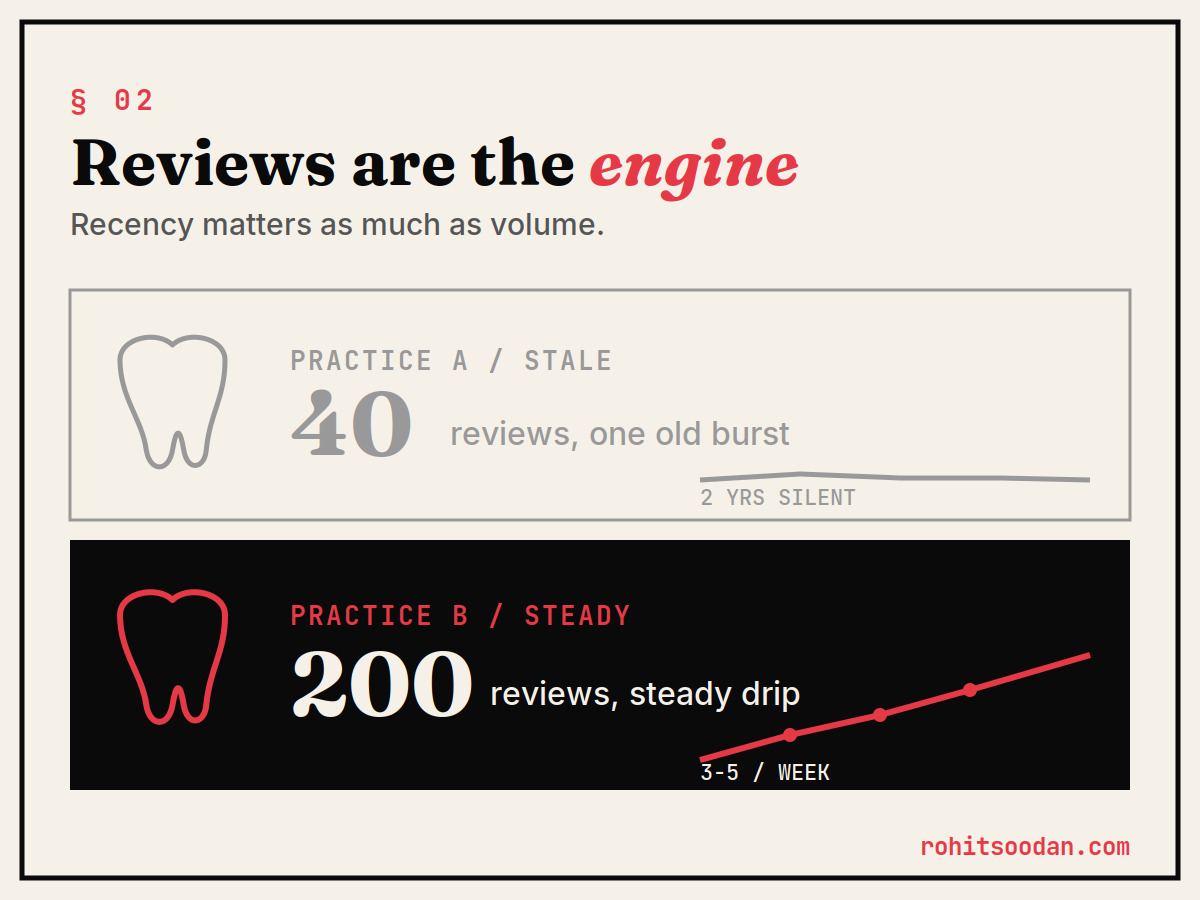
There’s no magic threshold, but the pattern is hard to miss. The practices sitting pretty in the top three of the map pack tend to have well over a hundred reviews, often north of 150, holding a 4.5-star average or better. A practice with 200 solid reviews will, all else equal, walk past one stuck at 40. But raw count isn’t the whole story. Recency and steadiness matter just as much. A trickle of three to five fresh reviews a week tells Google you’re alive and busy. Forty glowing reviews that all landed in one frantic burst two years ago? That’s a museum exhibit, not a signal.
So make asking a habit, not a heroic once-a-quarter campaign. The sweet spot is right after a good appointment, while the patient’s still feeling the relief and the goodwill. Train the front desk to ask out loud, follow up with a text that drops them one tap from your review page, and get out of their way. When reviews come in, answer them, the warm ones and the prickly ones both. A calm, human reply to a complaint tells every future patient reading along that you give a damn, and it tells Google your profile is anything but abandoned.
One hard line, though. Don’t buy reviews, and don’t dangle a discount for a five-star rating. Google is good at sniffing this out, and the penalty costs more than the reviews were ever worth. Ask honestly and let the actual care carry it.
Local SEO for Dentists Starts With Pages That Speak to Your Neighborhood
Your website still pulls real weight, especially for the regular blue-link results under the map and for catching people researching a specific treatment before they commit. If you serve more than one area, your biggest opening here is location pages.
The logic is simple once it clicks. Google indexes pages, not businesses, so one lonely homepage struggles to rank across a whole spread of suburbs. The fix is a real page for each neighborhood you genuinely serve. But here is where nearly everyone face-plants: do not clone one page ten times and just swap the town name. Google spots that instantly, and it’ll drag you down faster than doing nothing at all.
Build a small handful of pages that actually earn their place instead. Name the real stuff: the landmark everyone navigates by, where to park, the school run that clogs the road at 3pm, the treatments those particular patients keep asking about. Toss in a short local FAQ covering appointment types and how you handle a true emergency.
One real neighborhood per page, full of details only a local would know. That’s what ranks, and that’s what makes someone think, oh good, they actually get it here.
While you’re in there, nail the boring technical bits. The site should load fast, behave on a phone, and put your number and booking button somewhere a person in pain can find in about two seconds. Nobody’s waiting out a slow page with a toothache.
Get Your Practice Mentioned Across the Web
The last big piece of local SEO for dentists is citations, which is just a fancy word for all the spots online that list your name, address, and phone number. Local directories, healthcare listings, the dental association site. When those details line up everywhere, they quietly vouch for you, confirming to Google that you’re a real, established practice and not a fly-by-night operation.
The whole trick is consistency. Your name, address, and phone number need to match to the letter everywhere they show up, right down to whether you wrote “Street” or “St.” Mismatched listings confuse the search engines and chip away at the trust you’re trying to build. Block out an afternoon, audit where you’re listed, fix the stragglers, and add yourself anywhere reputable you’ve been missing.
Don’t Ignore AI Search
Here’s the shift worth watching. More people are now asking tools like ChatGPT and Google’s AI Overviews straight up, things like “who’s a good dentist near me,” and getting one folded-together answer instead of a list of links. These tools pull from the same raw material you’re already tending: a clean, complete Google profile, consistent details across the web, and a healthy bank of recent reviews.
So the encouraging news is that the work in this guide quietly feeds your AI visibility too. No separate magic trick required, at least not yet. Just don’t assume the classic ten blue links are the only place patients are looking anymore.
What to Realistically Expect From Local SEO for Dentists
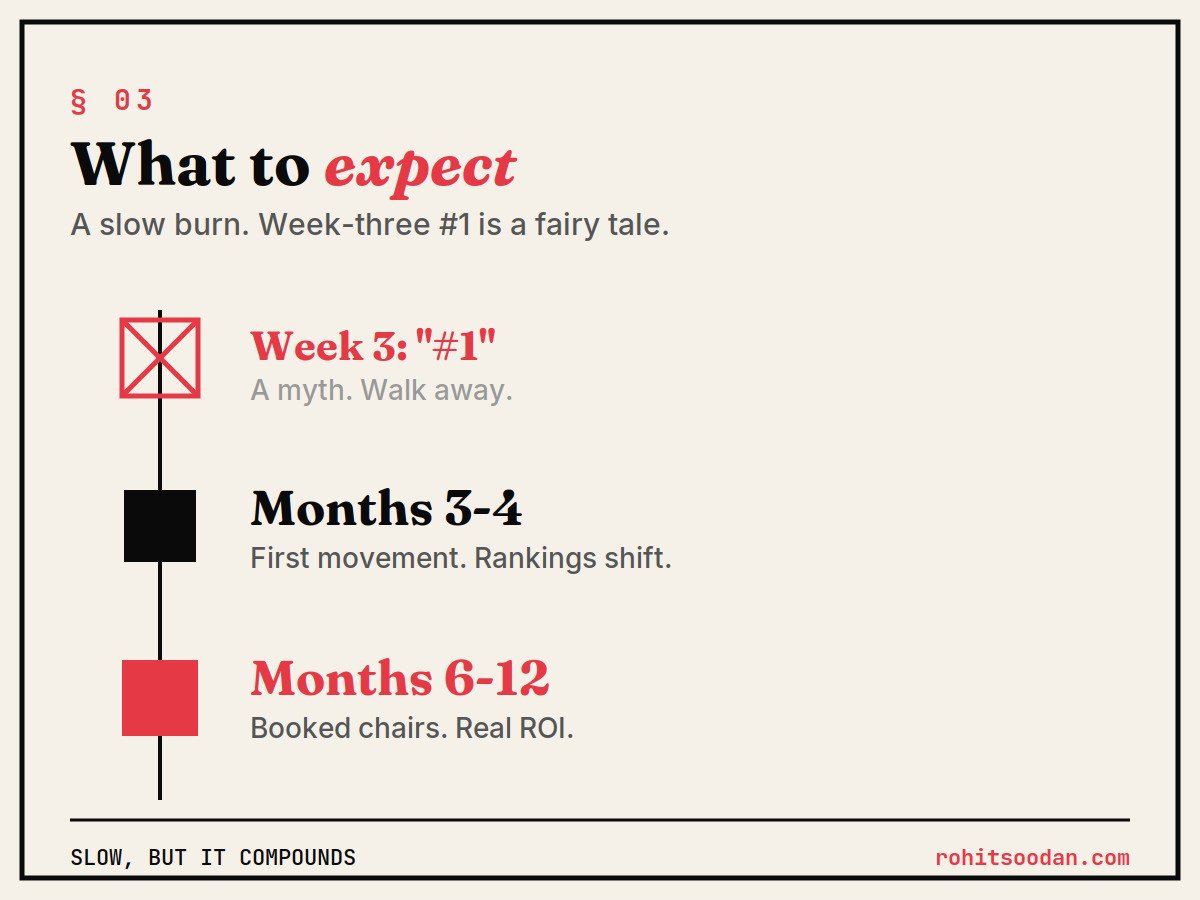
Let me set your expectations honestly, because any agency promising you the top spot in three weeks is selling a fairy tale. Most practices see the first real movement around the three-to-four-month mark, with the payoff that actually matters, more calls and more booked chairs, usually landing somewhere in the six-to-twelve-month range. In a genuinely cutthroat city, the top spots can take closer to a year.
I know that timeline tests your patience. But it’s also exactly why the work is worth doing. Local SEO is slow precisely because it’s durable. Once you’ve earned your place in the map pack with a strong, fresh review profile and pages that mean something to your neighborhood, you’re not bleeding money on every single click the way you do with ads, and a competitor can’t just outspend you overnight to knock you off.
So here’s where to start. Sort out the profile. Build the review habit until it’s muscle memory. Write a few pages that sound like they were written by someone who actually practices in that neighborhood. Clean up your listings. Do those four things and keep doing them, and local SEO for dentists stops being some mysterious dark art and turns into the steady, compounding engine that quietly fills your chairs, month after month, while you get back to the dentistry.
Frequently Asked Questions About Local SEO for Dentists
How much does local SEO for dentists cost?
Most dental practices invest somewhere between $1,000 and $3,000 per month for ongoing local SEO, with simpler single-location work sometimes landing lower and competitive multi-location markets running higher. Be wary of two extremes: anything under roughly $750 a month rarely buys enough real work to move the needle, and any agency guaranteeing a #1 ranking is waving a red flag. Price tracks with your market’s competitiveness, your website’s current health, and how many services and locations you’re promoting.
How long does local SEO take to work for a dental practice?
Plan for a slow burn. Most practices notice the first real ranking movement around three to four months in, with the results that actually fill chairs, more calls and booked appointments, typically arriving between months six and twelve. Highly competitive cities can push top positions closer to a full year. If you need patients right now while the organic work builds, running Google Ads or Local Service Ads is a reasonable bridge.
Can I do local SEO myself, or do I need to hire someone?
You can absolutely handle the foundations yourself: claiming and fully completing your Google Business Profile, fixing your categories, and building a steady review habit are all DIY-friendly and deliver most of the early wins. Where practices usually bring in help is the time-consuming or technical layer, location pages, citation cleanup, fixing a slow website, and ongoing strategy. The honest test is whether you’d rather spend those hours on SEO or on patients.
What is the most important local SEO ranking factor for dentists?
After proximity (how close you are to the searcher, which you can’t control), your Google Business Profile and your reviews are the two heaviest factors you can influence. A complete, correctly categorized profile makes you eligible to show up; a strong, recent review profile is what pushes you up the rankings and earns the click once you’re there.
Is local SEO worth it for a dental practice?
For most practices, yes. A well-run program commonly returns several times its cost over time because you’re capturing high-intent patients, people actively searching for a dentist today, rather than interrupting strangers. Unlike paid ads, the visibility you build compounds and doesn’t vanish the moment you stop paying. The catch is patience: it’s an investment that pays back over months, not days.
What’s the difference between local SEO and regular SEO?
Regular SEO chases rankings for broad, often nationwide search terms. Local SEO focuses on people physically near your practice searching with local intent, like “dentist near me” or “emergency dentist [your city].” It leans heavily on your Google Business Profile, the map pack, reviews, and consistent local business listings, signals that barely matter for a national blog but decide everything for a neighborhood dental office.
Running a dental practice and tired of watching competitors win the patients who should’ve been yours? I help dentists rank in the map pack and turn local searches into booked appointments. get in touch here and let’s get your chairs filled.